
Data and AI strategy
A staged plan that starts from the business problem, not the tool, and says what to deliver first.
Instead of a list of tools, a plan with priorities, timeline and cost that the board approves.
Consulting that turns what is scattered across the ERP, spreadsheets and systems into models and answers for whoever decides. From diagnosis to operation.
The first conversation is about understanding the problem, not a sales pitch.
The company has systems, spreadsheets and dashboards — and the questions that matter are still answered by gut feeling, or too late.
Demand, price and inventory come from someone's experience, with no measure of how wrong the guess is.
The number arrives at month end, assembled by hand, after the decision was made.
The proof of concept worked in a notebook and never reached the people who needed it.
The company wants to use AI, but nobody has defined which problem it should solve first.
Each practice solves part of the path between data and whoever decides. The end of each card shows what changes afterwards.
A staged plan that starts from the business problem, not the tool, and says what to deliver first.
Instead of a list of tools, a plan with priorities, timeline and cost that the board approves.
Forecasting, classification and clustering built for your case, put into production and monitored after delivery.
The sales target comes from a model with a stated margin of error, not from last year's spreadsheet.
Pipelines and storage that bring the company's systems into one reliable place and grow without a rewrite.
The executive dashboard wakes up up to date, with no three days a month copying numbers between spreadsheets.
Exploratory analysis, statistics and visualization to answer a concrete question, with the reasoning in view.
The meeting's question arrives answered, with the reasoning in view for anyone who wants to check.
Agents and workflows that do the repetitive work and hand to a person whatever they are unsure about.
Documents classified on their own, and only the doubtful case reaches a person.
Scenarios with a stated margin of error, to plan inventory, demand and capacity ahead of time.
Inventory and capacity planned ahead, with the pessimistic scenario on the table.
We also work on pricing, anomaly detection, document classification and any decision that today depends on scattered data.
The model left in a drawer is the one nobody put into production. Here, each step ends with something running — and you decide whether to move to the next.
We understand the decision that needs to improve, the data that exists and where it lives.
We propose the simplest solution that works, with timeline, cost and what is left out.
We build in short cycles, with the team that will use it reviewing the result at every stage.
We put it into production, check that the number stays right and leave the team ready to maintain it.
In one conversation, we understand the problem and tell you whether data and AI solve it, and where to start.
Not every problem calls for a project. When the bottleneck is the master data every system uses, we have our own product — built and operated in-house.
DynamicResearch
Master data management (MDM)
Products, suppliers and customers in one place, with rules at entry, a team responsible for each part and integration with the ERP you already use.
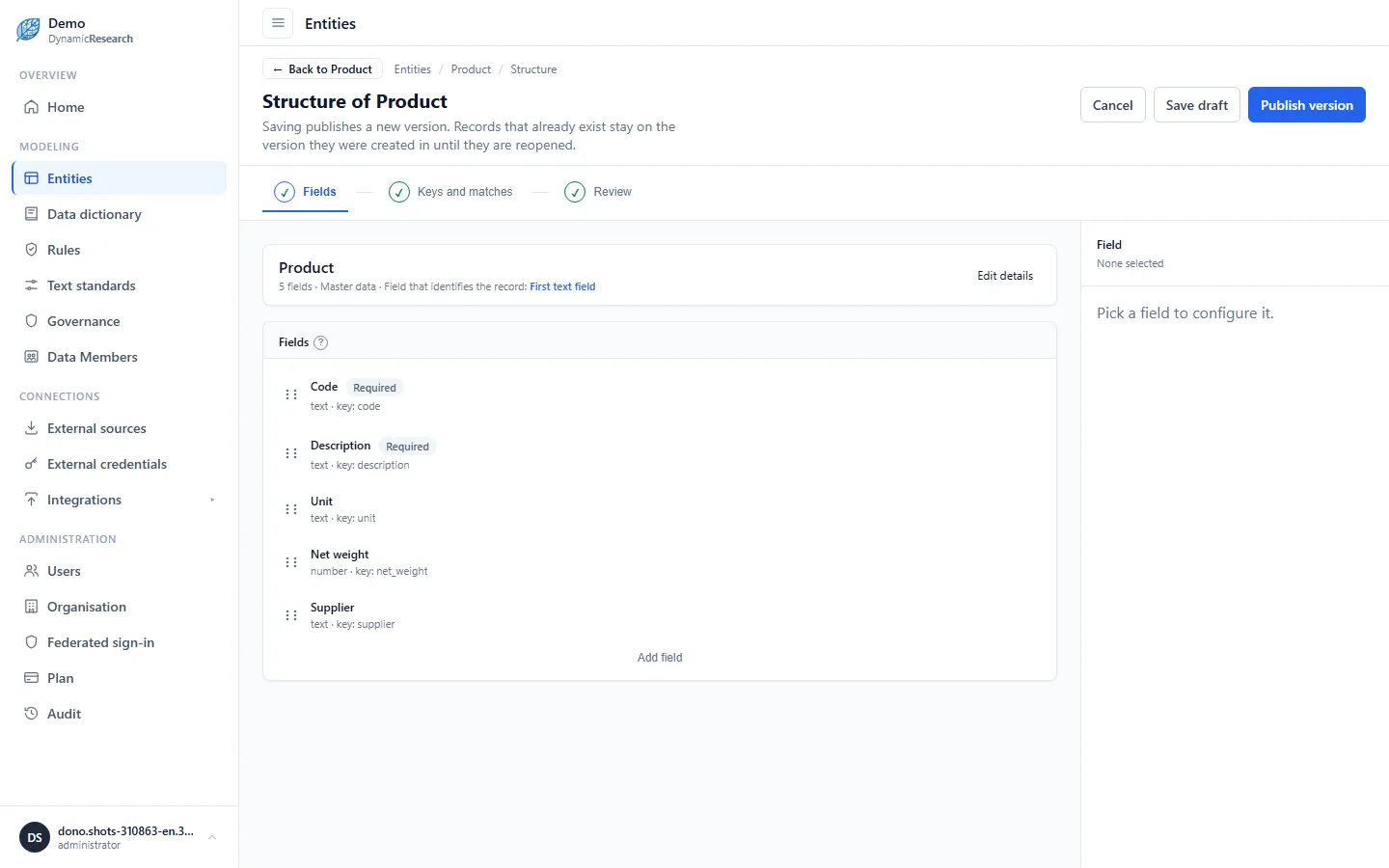
When master data is the bottleneck, the consulting team deploys Dynamic Research and connects models and reports to it.
No. Organizing the data is usually the first part of the work. The diagnosis tells what can be used as it is and what needs fixing first.
Yes. The solution connects to the ERP, spreadsheets and databases that already exist. Replacing systems is not a prerequisite.
It depends on the scope, but the first usable result usually comes in weeks, not months. We work in short cycles so you can follow progress.
You do. Code, models and project documentation are handed to the client, along with training for whoever will maintain them.
It depends on the problem and the size of the delivery. After the first conversation, we send a proposal with fixed scope, timeline and price.
Tell us which decision you want to improve and with what data. We reply to the email you leave here.